Mudskippers live in burrows self made by digging the ground up with their mouths and spitting the mud out. They use these burrows to hide from predators, temperature regulation, and to guard their eggs/larvae, these burrows can also reach around 1.5 meters in the ground. Females have a high fecundity and lay nearly 2,000 eggs per gram of body mass in their partners burrows during courtship. Spawning happens potentially across the year but usually during spawning seasons of Feburary and May. These eggs are on the ceiling of a specialized air-filled chamber created by gulping air from the surface and bringing it in their chamber which is how they keep themselves and their eggs oxygenated while submerged in water especially useful during high tide in a typically hypoxic environment such as mudflats.
After mating the female leaves the male’s burrow and the male safeguards the eggs until they develop for hatching. To prompt the eggs to hatch the father removes all the air from the chamber being gulping it up and spitting it back towards the surface. This fills the egg chamber up with water prompting the larvae to hatch out of the eggs and drift into the surface where a majority succumb to predation. Male mudskipper tend to help the larvae out of the burrows with different strategies reach the surface by creating some kind of current with tale undulation, turbulence by swimming towards the burrow, or relocation by transporting the larvae in the mouth. Species demonstrate one or multiple of these behaviors yet the exact behavior of Atlantic Mudskipper remains to be found.

After around 1 to 2 months the new mudskippers are able to defend themselves in their juvenile stage by burrowing in the mud and once they reach sexual maturity around the size of 10.8cm (males) and 11.8cm (females) on average, though they can reach maturation as early as 7cm (males) and 9cm (females). At maturity they’ll defend their territory aggressively, this territorial behavior is very pronounced in the Atlantic Mudskipper even for their species. When Mudskippers show off aggression against intruders they signal it by raising their first dorsal fin. If that signal doesn’t scare off the invaders they commence in battle which involves biting, leaping and opening their mouths.
Osmoregulation, Respiration, and Migration
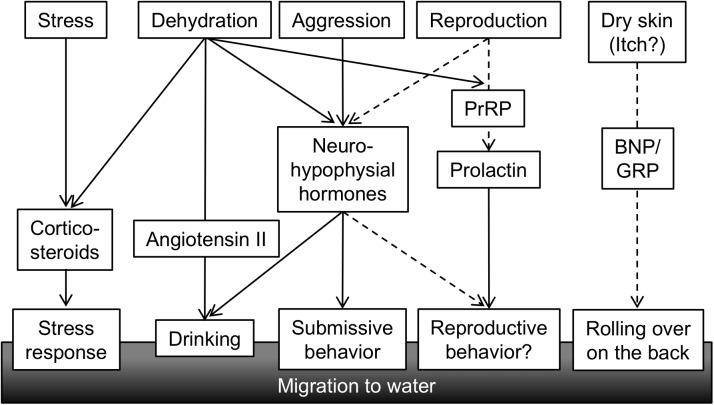
The Atlantic Mudskipper is a diurnal species, their genera like to spends most of its time on land than in water. Its ability to spend all this time on land by breathing in the air is thanks to a network of blood vessels in the surface of its skin, where they’re respiratory gasses are exchanged with the surrounding atmosphere. However there are behavioral patterns and motivators for it to migrate from land back to the water. One vital need for water is that its skin needs to be moist for it to respirate properly when emerged, usually to prevent its skin from drying Mudskippers would roll on its side to absorb the moisture from the ground into its body. Another vital prompt for it to is that its need to regulate itself both osmotically and ionically, a unique way it keeps up this regulation is by the hormone found in mammals: Angiotensin II. This hormone contracts the blood vessels to maintain blood pressure resulting in a stimulating of thirst for the animal, pushing for its behavior to ‘drink’ water in events of dehydration. Other fish especially, saltwater fish regulate by drinking to, but since they’re constantly in the ionized water they don’t need to stimulate thirst.
Social stimulus can motivate mudskippers as well, whenever mudskippers would make some form of communication they’d exerted high numbers of neurohypophysial hormones particularly vasotocin. These specific behaviors that were categorized as reproductive with them heading back to their burrows to spawn eggs/reproduce and submission to avoid stronger competitors. This is evidence for how these hormones also play a role in osmoregulation by stimulating behaviors that would cause them to migrate back into the ocean.
Under stressful situations these receptors regulated their mood and increase these hormones create another connection in how its behavior plays into its important function to osmoregulate and by extent its migration habits between aquatic and terrestrial environments.
Stress is another factor in osmoregulating/water migrating behaviors. Stress is tied to a steroid hormone called corticosteroids, corticosteroids contained specialized protein receptors such as the glucocorticoid receptor and mineralocorticoid receptor. These proteins have the dual purpose of stress response and osmoregulation, mitigating their mood while also stimulating the need to move towards water to excrete ion in their skin.